 on September 8, 2026
Property Management Articles
on September 8, 2026
Property Management Articles TLDR: Property management maintenance software falls into two categories. All-in-one platforms like AppFolio and Buildium bundle maintenance with leasing and accounting, while maintenance-first platforms such as Lula, Property Meld, and Latchel focus on repair speed, dispatch, and automation. This guide compares leading platforms across both categories so property managers can find the right fit for their portfolio.
Property management maintenance software centralizes work orders, Pro coordination, and cost tracking, letting teams manage repairs from request to resolution in one system. Residents expect timely updates, and owners demand transparency. Pros need clear direction. When these operations live in disconnected tools, requests fall through the cracks and response times suffer.
This gap is driving many operators to rethink their tech stack in 2026, seeking systems that connect to their core property management platform. The goal is a connected ecosystem that automates maintenance scheduling software, centralizes communication, and provides clear visibility from request to invoice.
Not all maintenance tools take the same approach. Some act strictly as digital tracking databases, while others use analytics, smart dispatching, and service execution to actively remove friction. The right fit depends on your team’s structure, goals, and portfolio scale.
Maintenance also carries weight far beyond the work order queue. A slow repair pipeline drives up days vacant, erodes NOI, and burns out the coordinator who fields every escalation. The category you pick shapes how much of that pressure the software absorbs and how much still lands on your team.
Property Management Software vs. Dedicated Maintenance Tools: What’s the Difference?
A property management system runs the whole rental business, with maintenance as one module alongside leasing, accounting, and reporting. Dedicated maintenance software is purpose-built for the repair lifecycle, from intake through dispatch, execution, and close-out.
Two approaches dominate the market. All-in-one platforms such as AppFolio and Buildium keep maintenance inside a broader system. Maintenance-first platforms, including Lula property maintenance, concentrate on repair speed, Pro coordination, and workflow automation, then integrate with the PMS you already run.
What Property Management Maintenance Software Actually Does
At its core, property management maintenance software unifies work orders, communication, expense tracking, and job history in one place. It keeps owners and residents informed without manual follow-ups, and it gives coordinators a single place to see where every job stands.
Real-time logging builds asset history that shows what a failing component puts at risk. That history makes the captive moment at turn, when a unit is vacant, the cheapest time to replace equipment before a mid-lease failure forces it.
Good software also standardizes the front end. Intake, triage, and scheduling follow the same path every time, so the routine handles itself and the team works the exceptions and the judgment calls.
It also coordinates the people doing the work, keeping licensing, insurance, and job status attached to each Pro. A coordinator can dispatch a job and confirm completion without stitching together texts and voicemails. That single record turns a pile of open requests into a queue a team can actually work.
What Maintenance Software Costs, And Where It Pays Back
Maintenance is a large, recurring line item, and it is easy to lose track of. The IREM Income/Expense IQ National Summary put repairs and maintenance at about $919.54 per unit per year in 2024. Multiply that across a portfolio and small pricing gaps compound quickly.
The common failure is invoices that land over budget with no way to catch the overage upfront. Lula property maintenance answers that with a flat-rate pricing catalog of 600+ common jobs, where the quote is the invoice. Completed work is billed as a single line item, and Lula earns only on completed work.
Predictable pricing also changes the conversation with owners. When the quote is the invoice, the maintenance line in an owner report holds up to scrutiny, with no surprise overages later. That predictability is easier to defend than a monthly average that swings with every emergency.
Operators who run in-house W-2 technicians have a different cost problem: visibility. Foresight surfaces real-time cost per door and per work order, and its quality-control automations flag overpriced work orders and missing photos. That turns scattered spend into numbers a team can actually manage, and it exposes the outliers before they become a pattern.
Where Most Property Management Maintenance Software Falls Short
The gap most teams feel sits between logging a request and resolving it. Software can capture a work order cleanly and still leave the hard part, getting a qualified Pro on site, entirely manual.
Three problems show up repeatedly:
- Information trapped in silos: requests arrive by call, text, and portal, and details get lost between them.
- Weak tracking and accountability: without status visibility, jobs stall and nobody owns the delay.
- Passive tracking over active execution: a database logs the request but does not dispatch, schedule, or close the loop.
Closing that gap is the difference between a system that records maintenance and one that moves it forward.
The Best Property Management Maintenance Software in 2026
Rather than crown a single winner, it helps to weigh platforms against the job you need done. The two categories, all-in-one and maintenance-first, solve different problems, and the strongest setups often pair one of each.
| Software | Category | Best For | Key Strengths | Considerations |
|---|---|---|---|---|
| Lula | Maintenance-First | Fast, high-volume coordination across multiple properties | Combines automation, smart scheduling, and a nationwide network of vetted professionals. | Market coverage continues to expand across new regions, though it already integrates with all major PMS solutions. |
| Property Meld | Maintenance-First | Teams focused on analytics and workflow optimization | Strong reporting tools and satisfaction insights. | Works best with existing vendor networks rather than providing one natively. |
| Latchel | Maintenance-First | Property managers seeking 24/7 maintenance coordination | Outsourced communication and scheduling for routine repairs. | Complex or specialized requests may still require direct management involvement. |
| Lessen | Maintenance-First | Enterprise and institutional portfolios | Scalable maintenance and turns through a managed professional network. | Tailored primarily for large-scale operators. |
| AppFolio | All-in-One | Comprehensive property management operations | Integrated accounting, leasing, and maintenance request intake. | Broader functionality may exceed the needs of smaller property maintenance teams. |
| Buildium | All-in-One | Accounting-driven property management | Detailed templates, portals, and reports. | Better suited for overall property operations than specialized maintenance execution. |
| Rentvine | All-in-One | Modern, cloud-based management for growing portfolios | Clean interface and responsive support. | Feature depth still developing as the platform evolves. |
| DoorLoop | All-in-One | Teams seeking CRM and operations in one system | Easy navigation and solid integrations. | May overlap with existing PMS tools depending on your setup. |
| SecondNature | Resident Experience | Preventive maintenance programs and resident services | Helps reduce work orders through proactive maintenance plans. | Complements, rather than replaces, full maintenance platforms. |
Choosing the right fit comes down to your operational goals. Whether your priority is rapid repair times, robust reporting, or direct data flow, every provider approaches daily operations differently.
Below is a deeper look at these top-tier platforms, starting with specialized, maintenance-first systems before diving into comprehensive, all-in-one platforms.
1. Lula
Category: Maintenance-First
Best For: Property management companies overseeing 150+ units who want automation, visibility, and a built-in network of licensed professionals.
Overview:
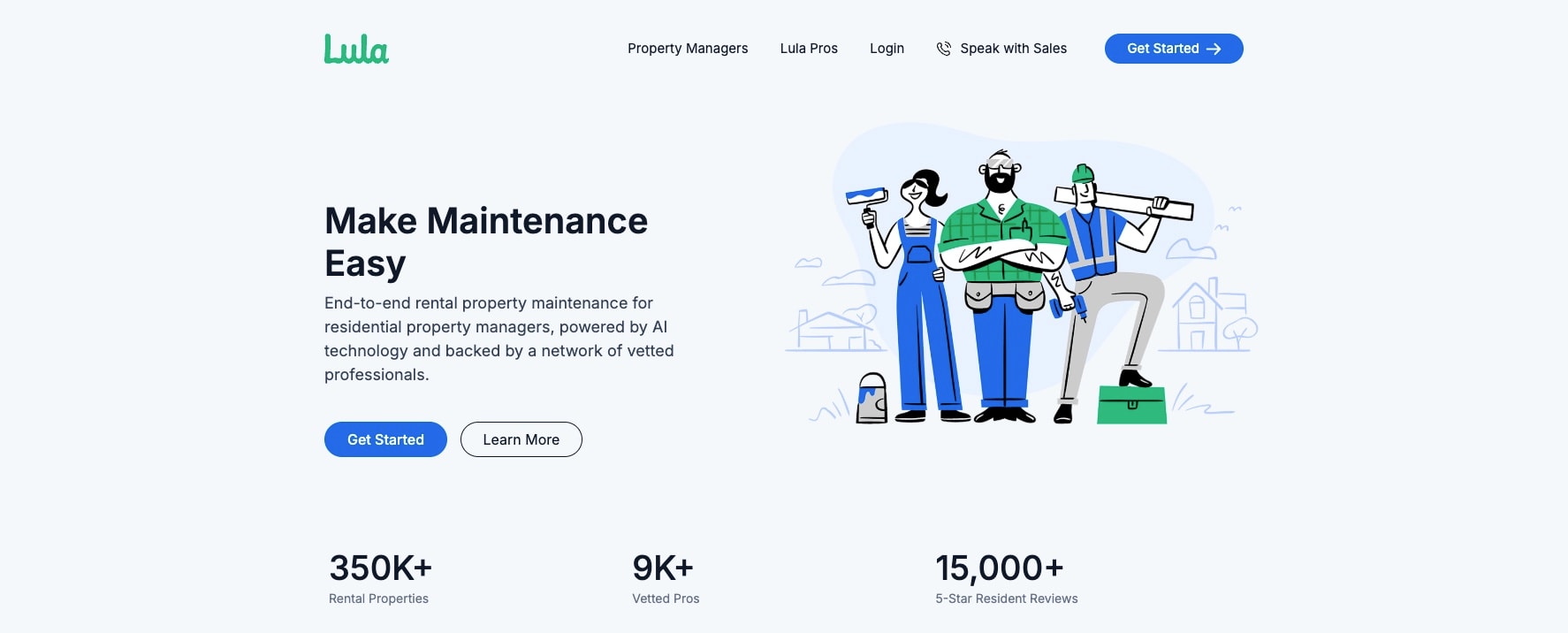
Lula provides a complete maintenance ecosystem that combines intelligent software with nationwide service delivery. Operating across more than 50 markets with a vetted network of over 9,000 licensed professionals, the platform handles on-demand repair execution alongside traditional workflow management.
By integrating with leading PMS and maintenance systems like Property Meld, Buildium, Rent Manager, Rentvine, and AppFolio, Lula gives property teams a connected workflow from intake to completion, uniting technology and hands-on service in one place.
Key Features:
- Centralized work order management with real-time visibility for property teams and owners
- AI-powered triage and scheduling that prioritizes and routes requests automatically
- Coordination between residents, vendors, and managers in one place
- Fast unit turns through Lula’s Make-Ready Services
- Access to a nationwide network of 9,000+ vetted, licensed professionals
- Direct integrations with Property Meld, AppFolio, Buildium, Rent Manager, and Rentvine
Pricing:
Lula has no subscription fees. It operates on a per-job model shared between service providers and property owners, with no direct cost to property managers. Lula offers flat-rate pricing, which helps keep repair costs down.
Considerations:
Market coverage continues to expand into new regions and service verticals.
2. Property Meld
Category: Maintenance-First
Best For: Teams that manage in-house or preferred vendors and want advanced analytics and workflow visibility.
Overview:
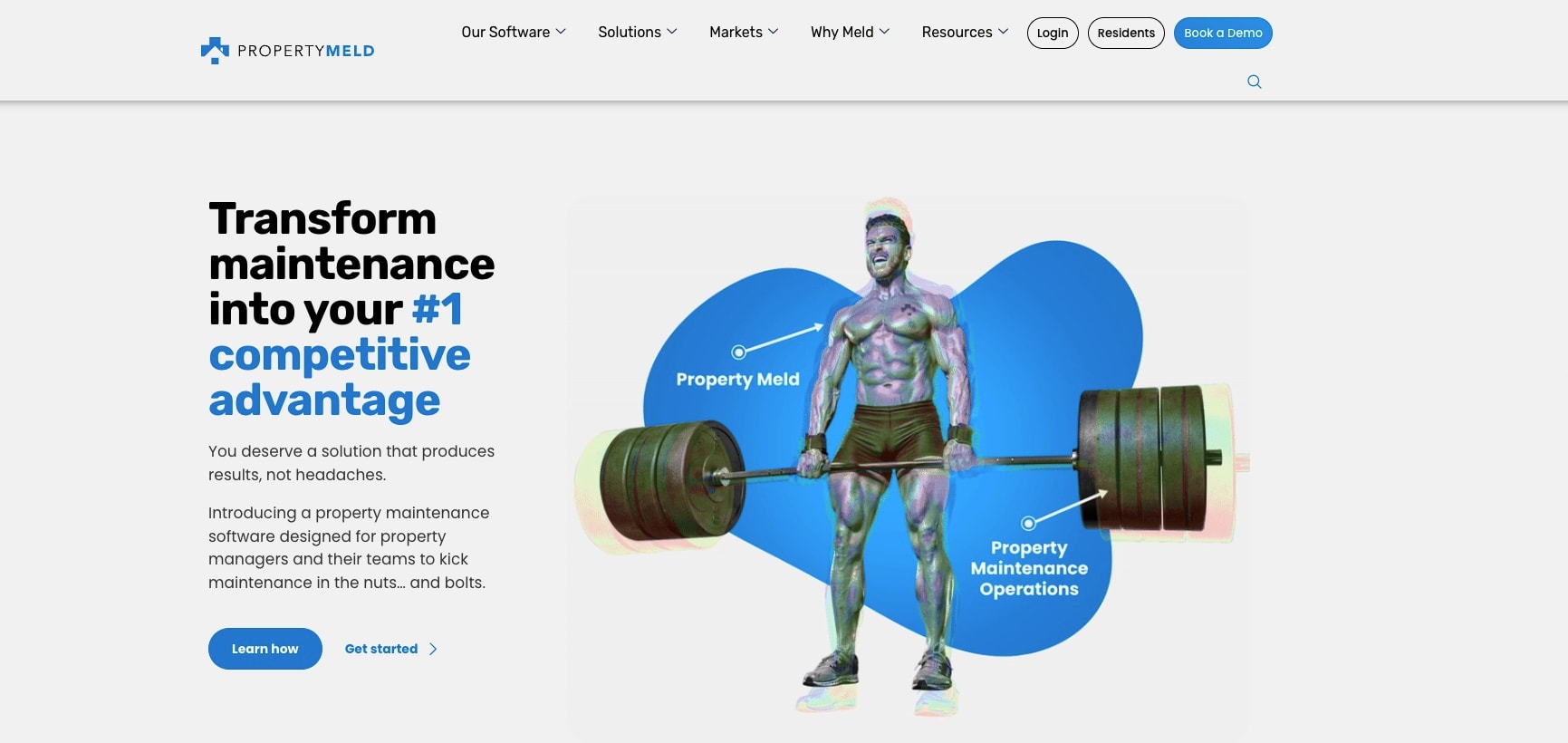
Property Meld is a maintenance-first software platform designed to help optimize property maintenance operations through better communication, analytics, and process automation. Its platform centralizes maintenance requests, vendor coordination, and resident communication in one place, giving operators real-time insight into performance and satisfaction metrics.
Through the Vendor Nexus partnership with Lula, Property Meld users can now directly access Lula’s national network of vetted, licensed vendors from within their Meld account. This integration pairs Meld’s work order management and performance tracking with Lula’s execution network, helping property managers resolve maintenance requests faster and maintain visibility across every job.
Key Features:
- Centralized work order management and tracking
- Vendor and resident portals for clear communication
- Satisfaction analytics and performance reporting
- Custom workflows for different property types
- Integration with Lula via Vendor Nexus for direct access to a vetted national vendor network
Pricing:
Subscription-based model with tiered pricing depending on portfolio size and features.
Considerations:
Best suited for property managers that already have vendor relationships in place or want to integrate directly with Lula for expanded coverage and faster service delivery.
3. Latchel
Category: Maintenance-First (Outsourced Coordination)
Best For: Property managers who want to offload maintenance communication and coordination while maintaining visibility into service performance.
Overview:
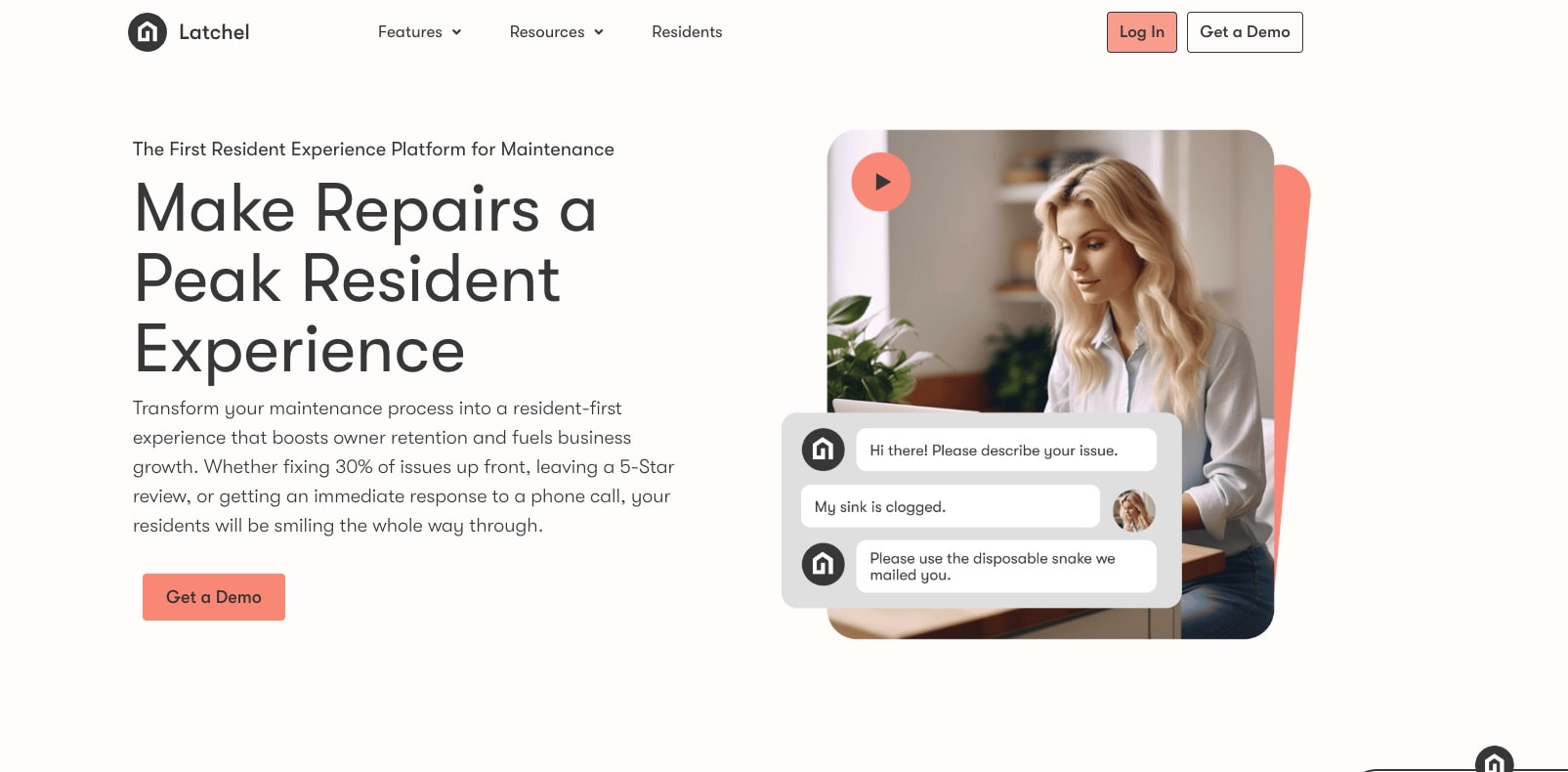
Latchel provides outsourced maintenance coordination services for property managers seeking 24/7 coverage without expanding their internal team. Residents report maintenance issues directly to Latchel, which handles troubleshooting, vendor dispatch, and resident communication. Property managers stay informed through updates and reports, allowing them to maintain oversight without day-to-day involvement.
Key Features:
- 24/7 maintenance coordination and support
- Automated resident communication and status updates
- Vendor scheduling and troubleshooting assistance
- Optional resident benefit packages and add-on services
Pricing:
Subscription-based model with pricing tiers based on unit count and selected service level.
Considerations:
Latchel is ideal for teams that want to delegate communication and scheduling, though complex repairs or specialized vendor selection may still require direct oversight from the property manager.
4. AppFolio and Buildium
Category: All-in-One Platforms
Best For: Property-management teams seeking a unified environment for leasing, accounting, maintenance, and reporting.
Overview:
AppFolio and Buildium are two of the most widely used all-in-one property-management platforms. Each provides a comprehensive operating system for property managers, combining accounting, communication portals, leasing, and maintenance modules in a single interface. Their maintenance tools integrate directly with financial and reporting features, giving managers full operational visibility across portfolios.
Through direct integrations with Lula, AppFolio and Buildium users can manage property maintenance end-to-end without leaving their PMS. The integration pairs each platform’s property-management capabilities with Lula’s coordination tools and nationwide network of licensed, insured vendors, helping property teams resolve work orders faster, reduce owner churn, and maintain a transparent experience for residents and owners alike.
Key Features:
- Centralized accounting, leasing, and maintenance workflows
- Resident and owner portals for communication and reporting
- Integrated maintenance tracking tied to financial performance
- Direct Lula integration for automated triage, coordination, and quality assurance
Pricing:
Subscription-based model with pricing tiers that scale by unit count and feature selection.
Considerations:
Best suited for teams that want all property operations in one system and the ability to extend maintenance capabilities through Lula’s integrated service network.
5. Other Notable Options
- Lessen serves enterprise and institutional portfolios with a managed vendor network and standardized workflows, offering scalable maintenance and turn services for large operators.
- Rentvine provides a modern, cloud-based property management software for small to mid-sized managers, combining clean design, responsive support, and integrated leasing and maintenance tools. Through its direct integration with Lula, Rentvine users can extend those capabilities with automated maintenance coordination and access to Lula’s nationwide vendor network.
- DoorLoop, a fast-growing property management software, offers a similarly modern interface and is designed for teams seeking CRM and property operations tools in one system, supporting efficient communication and portfolio oversight.
- SecondNature focuses on specialized areas of property operations by offering preventive-maintenance and resident-benefit programs that complement existing property management systems.
How Lula Redefines the Category
Lula property maintenance brings a network of 9,000+ vetted, licensed, and insured Pros across 50+ US markets. That network is backed by 350,000+ properties served and 15,000+ five-star reviews. The ecosystem is built in three distinct layers, each aimed at a different operator.
| Layer | Purpose | What It Solves |
|---|---|---|
| Foresight | AI-driven triage, routing, and scheduling | Removes manual prioritization and dispatch delays. |
| Maintenance Coordination | Centralized work order management, communication, and reporting | Keeps every request visible, trackable, and consistent across teams. |
| Make-Ready Services | Managed unit turns with standardized scopes and vetted pros | Speeds up turns, reduces vendor juggling, and improves move-in readiness. |
LuMi, Lula Maintenance Intelligence, is the intelligence that runs across the ecosystem. It handles white-labeled intake across voice, text, and web, and powers the scheduling and pricing intelligence inside Foresight. It is trained on 7 years of proprietary Lula maintenance operations and 500,000+ work orders.
For portfolios running maintenance across a decentralized Pro network, that combination gives coordinators one place to route and close every work order. Jobs are scheduled within 24 hours.
What To Look For In Property Management Maintenance Software
The right platform depends on your portfolio, but five criteria separate a useful system from a data-entry chore:
- Integration with your existing stack: it should connect to your PMS, not force a replacement.
- Mobile accessibility: coordinators, technicians, and Pros need the same view in the field.
- Work order automation: triage, dispatch, and scheduling should move without constant manual input.
- Pro management: licensing, insurance, and ratings should be tracked in one place.
- Reporting and analytics: cost per door and per work order should be visible, not buried.
Weigh these against how your team actually works before you shortlist anything.
How Faster Maintenance Protects Resident Retention
Maintenance quality tracks closely with whether residents stay. Zillow’s 2025 Consumer Housing Trends Report found that 68% of tenured renters cite a well-maintained property as a reason they stay.
There is also a blind spot on the operator side. In Zego’s 2025 Resident Experience Management Report, a survey conducted by SA Marketing Insights for property-management platform Zego, renters ranked poor maintenance the #2 reason they do not renew, while property managers ranked it 12th. That gap suggests many teams underweight exactly what residents weigh most.
These figures are correlational, not proof that faster repairs cause renewals. Still, the pattern is consistent. Responsive maintenance is a retention factor operators can act on directly, and slow response is one they cannot afford to ignore.
For a portfolio, the math is straightforward. Every avoided non-renewal saves a turn, the marketing spend to re-lease, and the days vacant in between. Maintenance that closes fast and communicates clearly is one of the few retention levers a coordinator controls without waiting on rent concessions or amenity upgrades.
How To Choose The Right Fit
Choose an all-in-one platform if your priority is running leasing, accounting, and maintenance from a single system and maintenance volume is manageable inside one module.
Choose a maintenance-first platform if repair speed, Pro accountability, cost predictability, and resident satisfaction are your priorities. Because these platforms integrate with your PMS, choosing one rarely means giving up the software you already rely on.
The decision often comes down to buyer type. Operators with fully outsourced maintenance need a staffed operation and a Pro network. Operators running in-house W-2 technicians need better visibility and scheduling for the team they already have.
Portfolio scale matters too: a few dozen units may run fine on a coordinator and a spreadsheet. That setup strains fast as door counts climb and after-hours volume grows. The point to switch is usually when manual follow-up eats the hours meant for real judgment calls.
A Faster, More Predictable Maintenance Operation Is Possible
Property management maintenance software should do more than record requests. It should move work from intake to a completed, well-priced job, keeping owners and residents informed the whole way. Lula property maintenance pairs a vetted Pro network and flat-rate pricing with LuMi-powered coordination, so that becomes the default rather than the exception.
Property Management Maintenance Software FAQ
How does property maintenance software improve operational efficiency for property management businesses?
The clearest signals are work-order age, first-touch time, and the share of jobs closed on the first visit. Software that centralizes intake and routing moves all three, which is where efficiency shows up in practice rather than in a feature list.
Can property maintenance software help reduce maintenance costs and equipment downtime?
Look past invoice totals and measure equipment downtime and repeat visits, which is where slow coordination quietly drains a budget. Lula property maintenance charges no monthly, setup, or subscription fee, so the cost of the tool scales with the work rather than your door count.
How does maintenance software improve resident satisfaction and overall efficiency?
Most after-hours calls turn out to be routine requests rather than true emergencies. Structured intake and clear escalation paths flag the real emergencies fast while routine requests wait for business hours. That protects both residents and on-call staff from burnout.
What is the difference between all-in-one property management software and maintenance-first software?
The real difference is depth versus breadth. An all-in-one PMS such as AppFolio or Buildium covers leasing, accounting, and maintenance, but treats repairs as one module, so maintenance reporting stays shallow. A maintenance-first platform such as Lula, Property Meld, or Latchel goes deep on the repair workflow, and for outsourced teams it adds labor capacity rather than only software.
Can property maintenance software integrate with my existing property management system?
Yes. Lula property maintenance connects to AppFolio, Buildium, Rent Manager, and Rentvine. During onboarding your unit and resident records import first, then work orders and invoices sync both ways, so nobody double-enters data between tools.
uble-enters data between tools.
Anything found written in this article was written solely for informational purposes. We advise that you receive professional advice if you plan to move forward with any of the information found. You agree that neither Lula or the author are liable for any damages that arise from the use of the information found within this article
