 on August 24, 2026
Rental Property Maintenance Software
on August 24, 2026
Rental Property Maintenance Software Pull a month of completed work orders and sort them by how close the final invoice landed to the approved not-to-exceed (NTE) limit. In portfolios running reactive maintenance, that distribution is rarely flat. Jobs cluster at the ceiling.
That clustering has a cause, and it is not vendor behavior. When a job is dispatched without a predicted cost, the NTE is the only number the vendor receives. It stops functioning as a ceiling and starts functioning as a target. Vendors are not exceeding a benchmark. They were never given one.
Everything downstream follows from that. Intake descriptions are vague, so scope is set on site. Every resident request arrives marked urgent, so emergency rates get applied to routine work. Coordinators approve to clear the queue. Property managers only learn the real cost when the invoice lands, at which point the work is complete and the overage is not contestable.
Predictive maintenance pricing changes the sequence. The cost expectation is set before dispatch rather than discovered after completion.
What Predictive Maintenance Pricing Is, and What It Is Not
Predictive maintenance pricing applies predictive methods to the financial decision rather than to the equipment. It uses cost history, job patterns, property attributes, and vendor performance to estimate what a repair should cost before the work is approved.
Industrial predictive maintenance does something different. It monitors assets through sensor data and usage telemetry to anticipate mechanical failure and avoid unplanned downtime. That discipline is mature, well documented, and built for manufacturing plants and fleets.
Rental portfolios have a different problem. The uncertainty is not usually whether the water heater will fail. It is what the repair will cost once someone is standing in front of it. Predictive maintenance pricing addresses the cost question. Preventive and predictive maintenance programs address the failure question, and the two operate together rather than in competition.
Where Reactive Maintenance Costs Are Actually Created
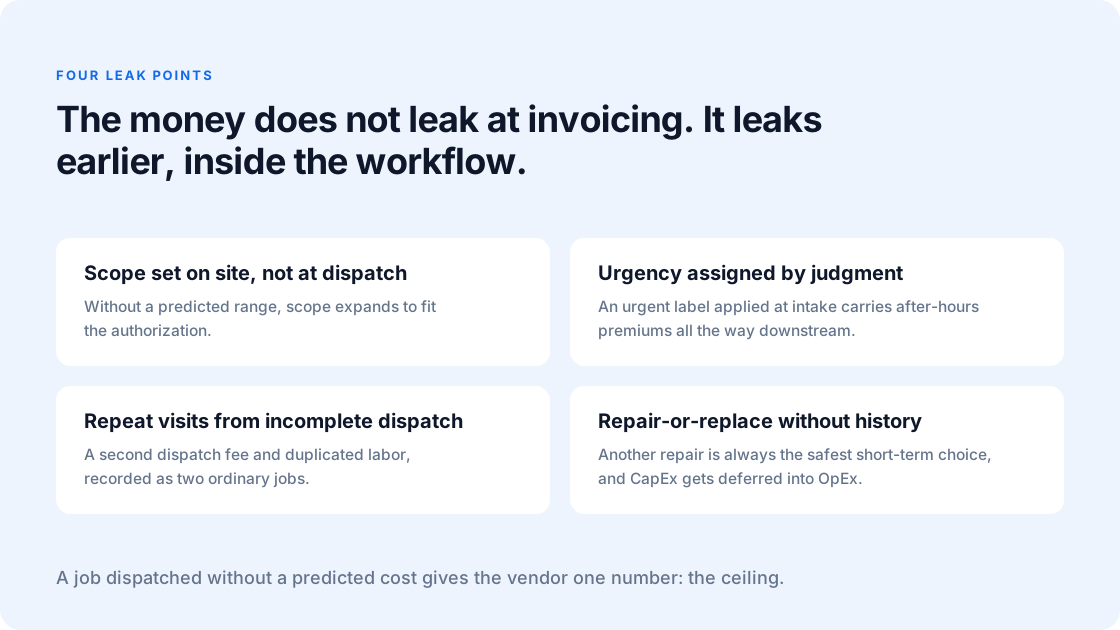
The money does not leak at invoicing. It leaks earlier, inside the workflow: at intake, triage, routing, vendor assignment, and mid-job decisions. Four points account for most of the maintenance cost a portfolio never planned for.
Scope set on site rather than at dispatch
Static NTEs assume every job is scoped accurately, described clearly by the resident, and performed consistently by the technician. Real intake rarely delivers any of the three. Job complexity varies, vendor labor rates differ by market, and the technician who arrives is the first person to see the actual problem.
Without a predicted range, scope expands to fit the authorization. A job authorized at one figure and invoiced well above it is common enough that most coordinators stop treating it as an exception.
Urgency assigned by judgment rather than by rule
When work orders enter the system labeled urgent, downstream cost rises automatically: after-hours premiums, rushed dispatch, higher vendor fees, and same-day visits that were not required.
Manual triage produces this because it is subjective. Residents overstate severity to get faster service. Coordinators escalate to protect themselves. Vendors respond to the label they are given. The label is applied once, at intake, by whoever picks up the request, and every cost decision downstream inherits it, including the response window the job is measured against.
Repeat visits from incomplete first dispatch
First-time fix rates fall when a job starts with an incomplete description, no diagnostic detail, or a vendor whose skill set does not match the trade required. The result is a second visit, a second dispatch fee, duplicated labor, and a resident who has now waited twice. The second visit rarely gets attributed to the first, so the pattern persists in the data as two ordinary jobs rather than one failure. Vendor scorecards are where that pattern becomes visible.
Repair-versus-replace decided without asset history
Without data on equipment age, historical repair cost, and failure frequency, the safest short-term choice is always another repair. Deciding when to repair an appliance and when to replace it requires history most teams do not have at the moment of the decision. A water heater patched five times in two years has been converted from an operating expense into a deferred capital expenditure (CapEx), and the operating budget absorbs the difference as deferred maintenance.
Why Static NTEs and Manual Budgeting Cannot Hold
Traditional NTEs and spreadsheet budgeting fail under real operating conditions for three structural reasons. None of them is a discipline problem.
- Human triage is inconsistent: When intake relies on judgment, urgency gets distorted and minor issues move through the system as emergencies. That sets the whole work order on the wrong trajectory before anyone has looked at cost. Standardized triage removes the variance at the point where it does the most damage.
- Vendors work without a cost benchmark: The NTE is usually set from habit rather than from data on that trade, that property type, and that market. A benchmark that was never derived from anything cannot constrain anything. This is a data-supply problem, and it is solvable at dispatch.
- Property managers have no baseline to approve against: With no historical cost model, every approval is made blind. There is no defensible answer to what a repair should cost across labor, materials, and job type, so NTEs get set high enough to avoid delays and the buffer becomes the spend.
How Predictive Pricing Works Inside Foresight
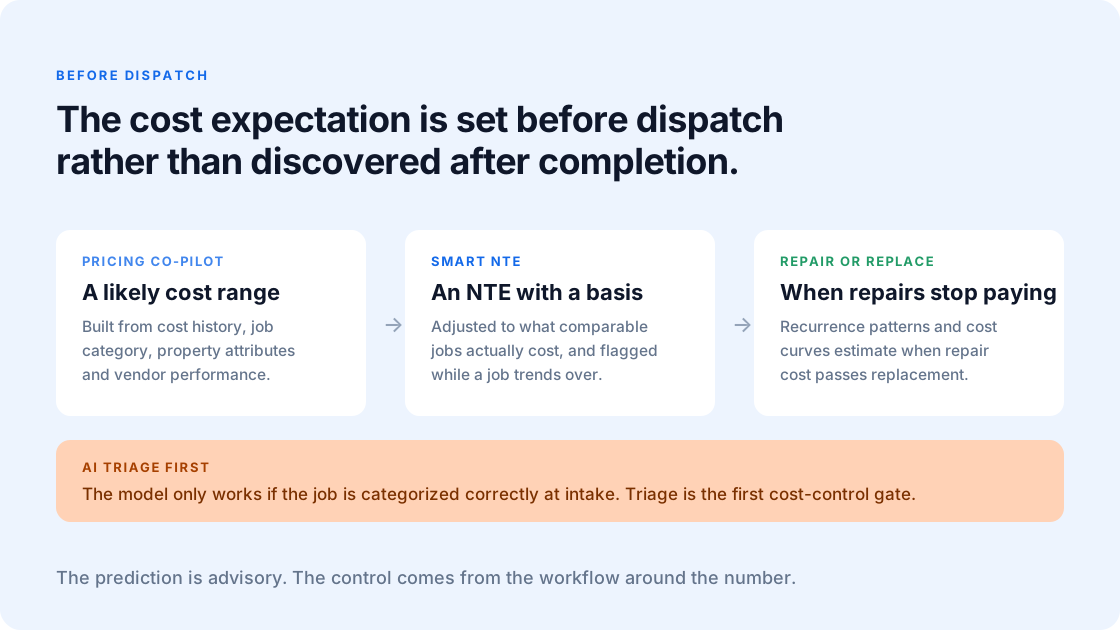
Foresight combines cost history, job patterns, and operational context to give property managers a cost expectation before a technician is dispatched. Four components carry it.
1. Predictive Pricing Co-Pilot
Analyzes historical cost patterns, job categories, property attributes, and vendor performance to generate a realistic cost expectation before dispatch. It surfaces the likely cost range for the work order, identifies which factors could move the outcome (trade, property type, seasonality, prior overruns), and gives the coordinator a data-backed view of what normal looks like for that job type.
2. Smart NTE Intelligence
Adjusts the recommended NTE using real-time context and the portfolio’s own cost history. It raises or lowers the figure based on what comparable jobs have actually cost, flags a job trending toward an overrun while there is still time to intervene, and reduces both under-funding, which delays work, and over-funding, which invites the clustering described at the top of this article.
3. Repair-versus-Replace Logic
Uses recurrence patterns and asset-level cost forecasting to estimate when continued repairs will exceed replacement cost. It surfaces assets with repeated failures or outlier spend and generates early indicators that a system is approaching end of life, which gives owners clearer capital planning visibility.
4. AI Triage as the First Cost-Control Gate
The pricing model only works when the job is categorized correctly at intake, which makes AI maintenance triage the first cost checkpoint. It classifies the job by trade, severity, and problem type, and prevents routine issues from being tagged as emergencies and priced accordingly.
What Predictive Pricing Does Not Fix
Predictive pricing sets a cost expectation. It does not perform the repair, and there are conditions under which it will not help.
- Thin history on a job type: A predicted range is only as good as the comparable jobs behind it. New trades, unusual property types, or markets with low job volume produce wide ranges or no range at all. The honest output in that case is a wide band, and a system that returns a confident narrow number on thin data is guessing.
- Genuine emergencies: A burst pipe at 2am costs what after-hours response costs. Predictive pricing prevents emergency rates from being applied to routine work. It does not reduce the price of an actual emergency.
- Structural and latent conditions: A prediction built on the intake description cannot price what nobody has seen yet. Water damage behind a wall, failed subfloor, and undocumented prior work will move a job outside any predicted range, and they should.
- Vendor supply constraints: In a market where one trade is short on capacity, the available vendor sets the price, which is a staffing-model question rather than a pricing one. Cost intelligence tells you the job is priced above the benchmark. It does not create an alternative.
- Approval discipline: The prediction is advisory. If coordinators approve past the flag to keep the queue moving, the system produces a record of overruns rather than a reduction in them. The control comes from the workflow around the number.
How to Tell If It Is Working
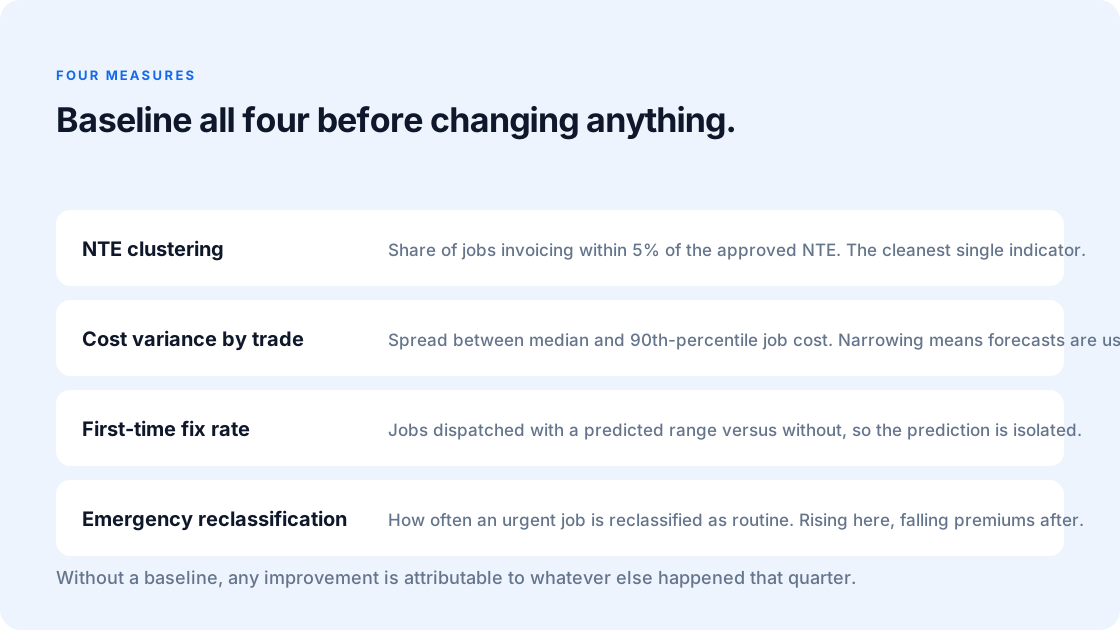
Cost intelligence is easy to claim and straightforward to measure. Four metrics show whether it is holding, and each can be baselined before rollout.
- NTE clustering: The share of completed jobs invoicing within 5% of the approved NTE. If predicted ranges are working, this distribution flattens and the ceiling stops behaving like a target. This is the cleanest single indicator.
- Cost variance by trade: The spread between median and 90th-percentile job cost, tracked per category. Narrowing spread means forecasts are becoming usable. This metric also tells you which trades to fix first.
- First-time fix rate: Measured against jobs dispatched with a predicted range versus without. This isolates the effect of the prediction from everything else changing in the operation.
- Emergency reclassification rate: How often a job tagged urgent at intake is reclassified as routine. A rising reclassification rate at intake should be followed by falling after-hours premium spend within a billing cycle or two.
Baseline all four before changing anything. Without a baseline, any improvement is attributable to whatever else happened that quarter.
Reactive Maintenance Will Always Cost More. Predictive Pricing Makes It Controllable
Costs discovered after the work is complete cannot be managed, only absorbed. That is the mechanism behind month-end surprises, and it is why disciplined teams still miss maintenance budgets.
Predictive maintenance pricing moves the cost decision to the point where it can still change the outcome: before dispatch, while the scope is still open and the vendor has not started. NTEs anchored to real cost history hold. Jobs that trend toward an overrun surface while there is time to intervene. Forecasts become defensible because they are built on distributions rather than on last year plus inflation.
Predictive pricing is already built into Foresight. If you want to see how it works on your own cost history, book a walkthrough.
Predictive Maintenance Pricing FAQs
Is predictive maintenance pricing the same as predictive maintenance?
No. Predictive maintenance monitors equipment to anticipate mechanical failure. Predictive maintenance pricing estimates what a repair will cost before the work is approved. One manages asset risk, the other manages financial risk, and rental portfolios generally need the second more urgently than the first.
Can predictive maintenance pricing work alongside a preventive maintenance program?
Yes, and they reinforce each other. Preventive maintenance schedules the work, such as annual HVAC servicing or planned tasks on critical assets. Predictive pricing sets the expected cost of that work. Together they produce a maintenance plan with both a calendar and a budget attached to it.
How much cost history is needed before predictions are reliable?
Enough comparable jobs in the same trade, property type, and market to produce a distribution rather than a point estimate. Common trades in established markets reach that threshold quickly. Uncommon work in low-volume markets may not reach it at all, and the correct output there is a wide range or no prediction.
Is flat-rate pricing an alternative to predictive maintenance pricing?
They solve the problem at different points. Flat-rate pricing sets the price from a published catalog before work begins, which removes variability for any job the catalog covers. Predictive pricing estimates the likely cost of work that falls outside a fixed catalog, where scope is genuinely unknown until someone is on site. Most portfolios need both: a catalog for the repeatable work, and a cost expectation for everything else. Lula’s flat-rate maintenance pricing covers the first.
Does predictive pricing replace the coordinator’s judgment?
No. It supplies a benchmark the coordinator did not previously have. The approval decision, the vendor conversation, and the exception handling stay with the operator. The system flags a job trending past its predicted range, and a person decides what to do about it.
Anything found written in this article was written solely for informational purposes. We advise that you receive professional advice if you plan to move forward with any of the information found. You agree that neither Lula or the author are liable for any damages that arise from the use of the information found within this article
