 on October 27, 2026
Property Management Articles
Knowing how to prioritize maintenance work orders by urgency means sorting every request into three levels and giving each a response window. A written framework keeps real emergencies from getting buried and gives you a defensible reason for every call. Lula’s maintenance coordination runs that same triage discipline across a portfolio.
It is 9 p.m. on a Tuesday in January, and three requests land in your queue within ten minutes. One resident reports a squeaky cabinet hinge. Another says water is dripping from under the dishwasher. A third says the furnace stopped and the unit is getting cold. All three are marked urgent, and all three residents sound equally worried.
Work them first-come-first-served and the hinge gets a Pro before the furnace does. With fully outsourced maintenance and no in-house technicians, the call on which job goes first falls to your coordinator, and it needs to come out the same way every time.
That is the gap a written triage system closes. This guide gives you one: three priority levels, a rubric for sorting requests into them, and response windows that keep prioritized work moving.
Why Work Order Prioritization Decides Everything Downstream
Prioritize by urgency rather than by arrival order. Classify each request as emergency, urgent, or routine using written safety-and-impact criteria. Then assign a response window to each level and work the highest level first.
That one call sets the tone for everything downstream, from dispatch timing to what the resident expects.
The stakes are high, and the industry data backs that up. Maintenance is the top stressor in Buildium’s 2026 report: 38% of rental owners say maintenance is their top source of stress.
- Key point: When everything is treated as urgent, nothing is. A no-heat-in-January call and a squeaky hinge should never share a first-come-first-served line.
What Triage Means for a Rental Maintenance Request
Triage is the fast evaluation of an incoming request to decide its true urgency and the right next step. You read the details and judge the risk before routing the work.
Triage is the first real decision in the maintenance coordination lifecycle. That flow runs from intake to triage, scoping and not-to-exceed, dispatch, follow-up, and close-out.
Triage is an early decision that shapes what happens next. That one call drives the after-hours dispatch and frames what the resident expects.
The Three Priority Levels (Emergency, Urgent, Routine)
Most residential teams sort work into three levels: emergency, urgent, and routine. The condition and its impact set the level, regardless of how upset the caller sounds.
Federal frameworks tier work the same way and attach a response window to each level. HUD’s federal work-order priority framework lists work as “#1 Emergency: Immediate; #2 Urgent: Same day; … #4 Routine: Within 72 hours.”
Emergency: Safety, Habitability, or Active Damage
Emergencies generally warrant an immediate response. They map to habitability and legal duty, which is why they jump the queue regardless of convenience.
- No heat or cooling in extreme weather
- No running water or no working toilet
- Sewage backup or active flooding
- A gas odor or exposed, sparking wiring
- A unit that will not secure
- A dead smoke or CO detector
Cornell Law’s Wex defines the standard clearly. The implied warranty of habitability requires landlords to maintain residential rental property in a condition that is safe and fit for human habitation.
You also carry a duty to preserve the property, so failing to act on a real hazard creates liability. Under HUD’s life-threatening standard, a Life-Threatening Deficiency requires proof of mitigation within 24 hours.
Urgent: Reduced Function, No Immediate Danger
Urgent work reduces function without putting anyone in danger.
Think a single appliance down, one dead outlet with power elsewhere, or a slow contained leak. A failed garbage disposal or lost cooling in mild weather also fits here.
These jobs need prompt scheduling rather than a middle-of-the-night dispatch. A same-day to a few-days window usually fits, which protects the resident without burning the after-hours premium.
Routine: Planned, Scheduled, and Preventive Work
Routine covers cosmetic fixes, minor wear, planned or preventive tasks, and non-safety requests handled in normal business windows.
Routine work still needs a committed window and a date on the calendar. A job with no owner and no clock is the one that silently ages into a bigger problem.
How to Prioritize Maintenance Work Orders by Urgency Using a Rubric
Gut-feel triage falls apart the moment two coordinators rule the same call two different ways. A short written rubric keeps the call consistent.
Score every request on two axes: safety and habitability risk, and operational impact. For impact, count how many units are affected and check whether active damage is making the unit unlivable.
- Key point: A boundary that moves with whoever took the call cannot be staffed or defended. Consistency beats the exact spot you draw the line.
Consistent intake data makes the score reliable. Require photos, a category, and a location on every request so the person triaging is judging facts.
Written criteria also let you standardize the call at volume. AI maintenance triage can classify the request and pre-score its urgency against your rules. This is how Lula’s maintenance coordination keeps the routine front end handled by automation, so your team works the exceptions.
Setting Response-Time Expectations by Priority Level
Each level needs a target response window that you actually hold to. A common pattern is emergency within 24 hours, urgent same day to a few days, and routine within a set number of days.
State law governs private landlords and varies by market, so treat federal windows as a reference. The point is written, consistent commitments that residents and owners can rely on.
Speed of acknowledgment matters as much as speed of repair. A fast first touch calms the resident long before the fix lands. Even a short message that says a Pro is scheduled does the job.
Handling After-Hours and Gray-Zone Calls
The hardest triage happens at night on partial information. The industry shorthand is “first, flood, or blood,” and the trouble lives in the gray zone between the two.
Gray-zone calls cause nightly arguments. Common ones: AC out in mild weather, one of two toilets clogged, a leaking dishwasher, or a disposal that quits at 11 p.m.
Rule them with a written escalation threshold so the answer does not depend on who picks up.
The cost runs in both directions. Over-calling emergencies burns overtime you did not owe, and under-calling turns a contained leak into an insurance claim.
You define what wakes the on-call contact. After-hours maintenance coverage applies those rules every night.
LuMi, Lula’s maintenance intelligence, handles the intake and the urgency call on your escalation rules, then routes only true emergencies to a person. LuMi works the routine front end so your coordinator handles the judgment calls.
Keeping Prioritized Work From Stalling
A priority is only as good as the follow-through behind it. A perfect triage call means nothing if the job then sits for two weeks.
- Vague intake: missing photos or details send a Pro back for a second trip.
- Owner approval: for third-party managers, the repair takes a day but the sign-off can take a week.
- A quiet Pro: a job with no status update quietly falls off everyone’s radar.
- Sloppy close-out: work marked done with no documentation invites a repeat call.
Owner approval is a third-party-PM bottleneck, so track it as its own step. Chase that sign-off before an urgent job stalls after a good triage call.
Watch aging work orders and time-to-first-response so stalled jobs surface before the resident calls back angry. Teams often learn a small repair became a costly turnover only because nobody saw the clock.
That aging is how triage failure feeds deferred maintenance backlogs. Tracking these metrics is core to scaling maintenance operations across hundreds of doors.
Why Getting Triage Right Protects NOI and Retention
Triage is an NOI decision as much as an operations one. The payoff shows up in two places: resident retention and reclaimed team capacity.
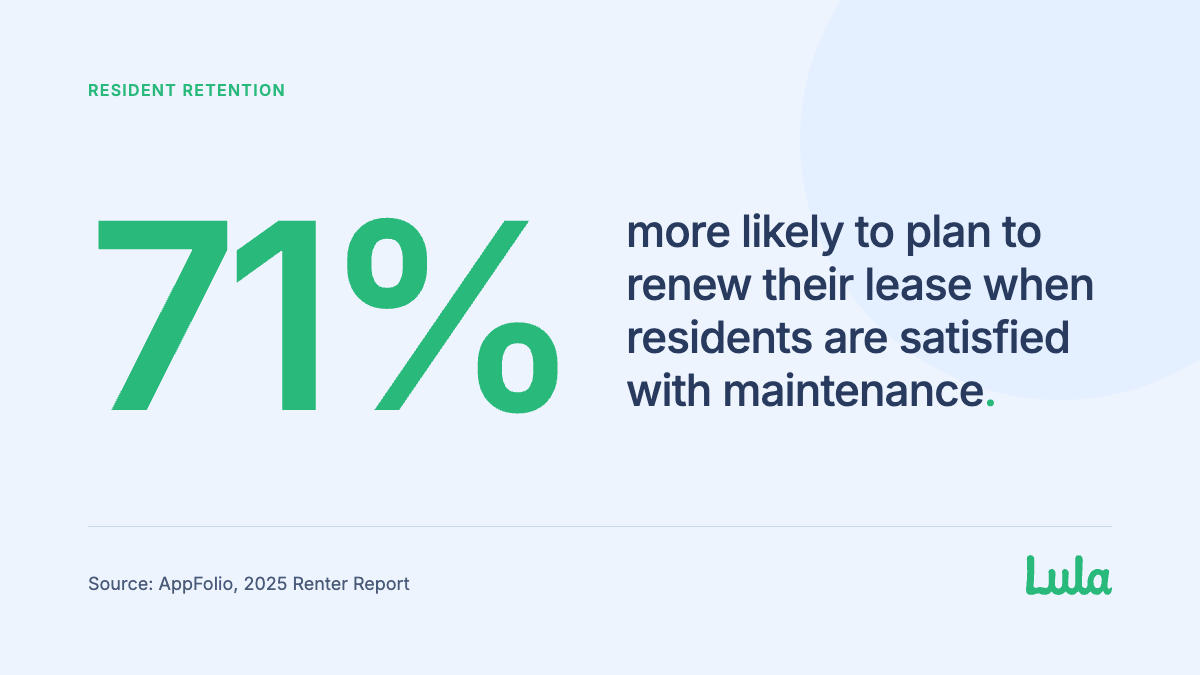
The retention payoff is measurable. AppFolio’s 2025 renter report found residents plan to renew more: those satisfied with maintenance are 71% more likely to plan to renew their lease.
Reactive work also quietly consumes your team’s capacity. Routine and reactive work dominates the calendar in AppFolio’s NAA research: 42% of the week goes to routine operational work and 24% to reactive tasks.
Here is what a triage system changes in practice:
| What Changes | Without A Triage System | With A Consistent Triage System |
| Incoming requests | Worked first-come-first-served | Classified by urgency at intake |
| Real emergencies | Buried behind low-stakes tickets | Worked first inside a set window |
| After-hours spend | Overtime burned on non-emergencies | On-call reserved for true emergencies |
| Resident experience | Callbacks and complaints | Fast first-touch acknowledgment |
| Aging work | Jobs stall unseen | Stalled jobs surface on a dashboard |
| NOI impact | Emergency premiums and turnover | More renewals and controlled costs |
How Lula’s Maintenance Coordination Makes Prioritization Predictable
A written framework plus the capacity to run it is what holds priorities in place. The framework tells you what to do, and staffing decides whether it happens at 2 a.m. and across hundreds of doors.
That second half is where most teams get stuck. A property management work order system records the ticket, but it does not carry the urgency judgment for you.
For teams with fully outsourced maintenance, Lula’s maintenance coordination applies consistent triage across voice, text, and web on your own escalation rules. It is backed by 9,000+ vetted Pros across 50+ US markets and 125,000+ work orders processed in 2025.
LuMi handles the routine intake so your coordinator works the exceptions, without adding headcount.
Work Order Prioritization FAQ
How Many Priority Levels Should A Maintenance Team Use?
Add a fourth planned or preventive tier only once recurring PM tasks start competing with reactive tickets for the same calendar. Audit your tiers each quarter for drift, since a level that keeps getting overridden signals the criteria need a rewrite.
Who Should Decide A Work Order’s Priority?
Name one owner of the final call plus a trained backup, so priority does not swing when the primary coordinator is out. Give that person written authority to override a default level, and require a one-line reason each time.
Does Fair Housing Affect How Requests Are Prioritized?
Apply the same urgency criteria to every resident and unit, prioritizing by the condition rather than the person. Document the reason for each priority call so your decisions stay consistent and defensible.
What Is The Difference Between An Urgent And An Emergency Work Order?
Beyond response time, the two differ in paperwork: an emergency needs a timestamped log of the hazard and the mitigation step. An urgent job just needs the scheduled date on record, which protects you if the call is later disputed.
How Do You Prioritize When Several Emergencies Come In At Once?
Rank first by risk to life and habitability, then by how far active damage is spreading and how many residents are affected. Pull in extra network capacity so true emergencies run in parallel instead of queuing behind each other.
Anything found written in this article was written solely for informational purposes. We advise that you receive professional advice if you plan to move forward with any of the information found. You agree that neither Lula or the author are liable for any damages that arise from the use of the information found within this article
